Analog Astronauts: Exploring Life at the Mars Desert Research Station
Discover what it takes to simulate a mission to Mars — right here on Earth. Explore the daily life, science, and teamwork that prepare humanity for the Red Planet.
Approximately 1 hour
7 screens with interactive quiz
Self-paced, all levels
How to Navigate
Use the "Next" and "Previous" buttons at the bottom of each screen. You can also click the progress dots above to jump to any completed screen. All content is presented sequentially across 7 screens.
Technical Requirements
This module works in any modern web browser (Chrome, Firefox, Safari, Edge). No plugins or downloads are required. An internet connection is needed to access linked resources.
Accessibility
This module is keyboard-navigable and screen-reader compatible. All images include descriptive alt text. Text maintains a minimum 4.5:1 contrast ratio. If you need accommodations, contact your instructor.
Learning Objectives
By the end of this module, you will be able to:
1Explain the role of an analog astronaut and the purpose of Earth-based Mars simulation missions.
2Describe key aspects of daily life at the Mars Desert Research Station, including living quarters, laboratories, and operational protocols.
3Identify at least three types of scientific research activities carried out during an MDRS simulation mission.
4Appreciate the challenges and benefits of conducting space mission simulations on Earth, including team dynamics and psychological factors.
A note from your instructor: Welcome to this exploration of analog space research. As you work through this module, think of yourself as a prospective crew member being briefed before your first rotation at MDRS. I encourage you to reflect on each section and consider how these Earth-based simulations advance our understanding of what it will take to live and work on Mars. Feel free to reach out via the course discussion board or email with any questions.
Screen 2 of 7 — Content
Life at the Mars Desert Research Station
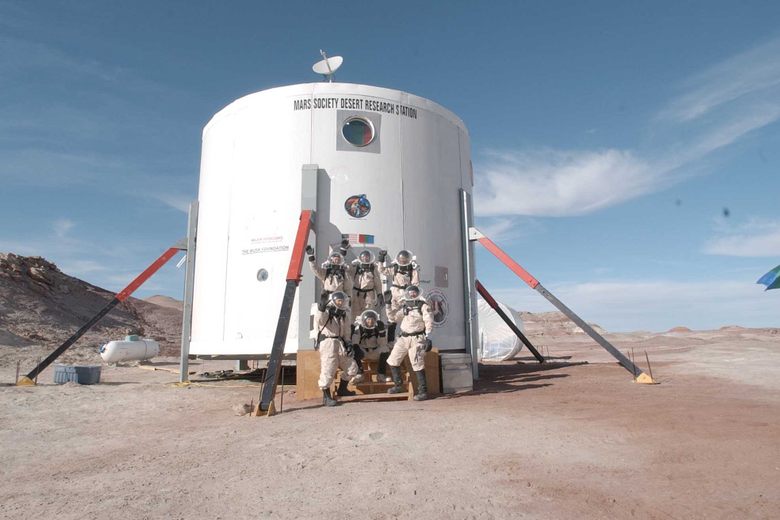
Nestled in the red desert of southern Utah, the Mars Desert Research Station is the world's largest and longest-running Mars analog facility. Here, crews of six to eight live and work under simulated Martian conditions for two-week rotations.
Image: The MDRS habitat exterior. Courtesy The Mars Society and MDRS Crews.
The Habitat
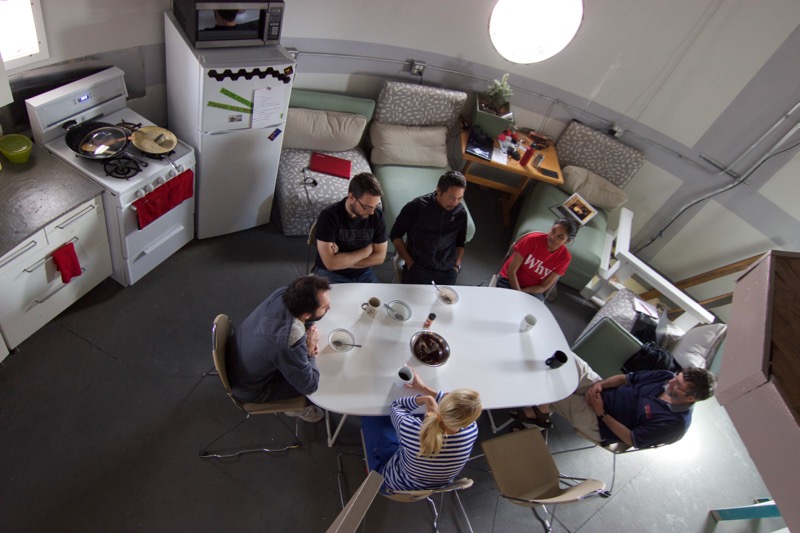
The main habitat structure (often called "the Hab") is a two-story cylindrical building roughly 8 meters in diameter. The upper deck houses the living quarters — individual crew staterooms, a shared kitchen and dining area, and a common workspace. The lower deck contains the EVA (Extra-Vehicular Activity) preparation area, storage, and an airlock that crews use when departing on simulated spacewalks. The Hab is intentionally compact, mirroring the space constraints astronauts would face in a real Mars habitat.
Supporting Structures
🔬
Science Dome
A geodesic dome that serves as the primary laboratory space for geology, biology, and engineering experiments.
🌱
GreenHab
A solar-powered greenhouse used for growing food and studying agricultural techniques for Martian settlement.
🔭
MDRS Observatories
The MDRS Observatories are made up of two different facilities, each with its own equipment and mission. The original observatory on the main campus, known as the Musk Observatory, is focused on Sun observations. The MDRS Robotic Observatory is located nearby the solar panel and is a fully automated facility that can be operated by crews or remotely.
📡
RAM Module
The Repair and Maintenance module provides workshop space for engineering projects and equipment upkeep.
Living Under Simulation Rules
During an active simulation, crew members follow strict protocols designed to replicate Mars conditions as closely as possible. All outdoor activities require wearing simulated spacesuits. Communications with "Earth" (Mission Support) operate on a simulated time delay. Water and power usage are rationed to mirror resource constraints on Mars. These rules are not arbitrary — they generate authentic operational data and force crews to develop the resourcefulness that a real Mars mission would demand.
Reflection Prompt
Consider the compact living space and shared facilities. How might confined quarters affect the psychological well-being and productivity of a small crew over a two-week period? How might this compare to a multi-month Mars transit?
Screen 3 of 7 — Content
A Day in the Life of an Analog Astronaut
Every day at MDRS is carefully structured to balance scientific productivity, station maintenance, personal well-being, and mission documentation. Here is what a typical day looks like.
Image: Interior of the Hab's upper deck during an active research rotation. Courtesy The Mars Society and MDRS Crews.
Typical Daily Schedule
While each commander may adjust the schedule slightly for their crew's needs, a standard MDRS day follows a consistent rhythm that balances productivity with rest. The schedule below represents a representative rotation day.
7:00 AM
Wake-up & Breakfast
Crew members rise and prepare breakfast from shelf-stable and dehydrated food supplies. A brief informal check-in sets the tone for the day.
8:00 AM
Morning Briefing
The commander leads a planning meeting to review the day's objectives, assign EVA teams, and coordinate research priorities.
9:00 AM – 12:00 PM
EVA or Lab Research
The core work block. Some crew conduct outdoor EVAs in simulated spacesuits to collect geological samples or test equipment. Others work in the Science Dome on experiments. The GreenHab crew tends plants and records growth data.
12:00 PM
Lunch & Midday Break
A shared meal followed by a short rest period. Crew members rehydrate, share observations, and recalibrate afternoon plans.
1:00 – 5:00 PM
Afternoon Research & Maintenance
Additional research, data analysis, station maintenance tasks (water system checks, power monitoring), and equipment repairs.
7:00 – 9:00 PM
Report Writing
Each crew officer submits daily reports: Commander's Report, Engineering Report, GreenHab Report, Science Report, EVA Report, and Journalist's Report. These go to Mission Support and become part of the public record.
6:30 PM
Dinner & Social Time
The crew prepares and shares a communal dinner — an important social ritual. Evenings might include movie nights, astronomy observation, games, or personal time.
10:00 PM
Lights Out
Crew members retire to their staterooms. Adequate rest is critical for cognitive performance and crew morale during the intensive rotation.
Key insight: The structure of a simulated Mars day is not just about logistics — it is a research instrument. By studying how crews manage time, resolve conflicts around shared resources, and maintain morale under pressure, researchers gather data directly applicable to planning actual crewed Mars missions.
Reflection Prompt
Daily report writing takes significant time but is essential for mission documentation. How does this practice parallel documentation requirements in your own professional or academic field? What might be lost if it were skipped?
Screen 4 of 7 — Content
Scientific Research Activities
MDRS is not merely a simulation exercise — it is an active research facility where crews conduct real science across multiple disciplines. The research conducted here contributes to both Mars exploration planning and terrestrial science.
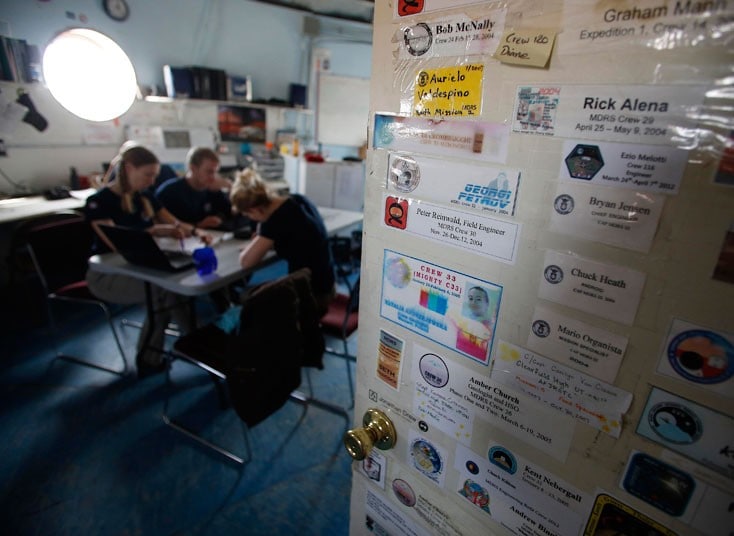
Image: A crew member conducts field geology during an EVA. Courtesy The Mars Society and MDRS Crews.
Research Disciplines
Research at MDRS spans a wide range of scientific and engineering fields. Each crew typically arrives with a portfolio of approved research projects that they will execute during their rotation. The following tabs explore the major categories of research conducted at the station.
Geology & Planetary Science
The terrain surrounding MDRS in the San Rafael Swell region closely resembles Martian landscapes, making it ideal for geological research. Crews conduct field mapping, collect and analyze rock and soil samples, and test remote sensing techniques. Research often focuses on identifying biosignatures — chemical or physical markers that could indicate past or present life. Geological EVAs train researchers to work efficiently in bulky suits while performing precise scientific fieldwork.
Biology & Astrobiology
Biological research at MDRS includes microbiology studies of extremophile organisms in the desert environment, plant growth experiments in the GreenHab, and investigations into closed-loop life support concepts. Crews grow vegetables under controlled conditions, testing which varieties perform best with limited water and nutrient inputs. Some rotations include spirulina cultivation experiments, exploring this nutrient-dense microorganism as a sustainable food and oxygen source for long-duration space missions.
Engineering & Technology
Engineering research encompasses everything from testing new spacesuit designs and EVA mobility aids to deploying autonomous rovers and drone platforms. Crews evaluate communication systems, 3D printing for in-situ manufacturing, solar power optimization, and water recycling technologies. These projects provide practical data on what technologies will function reliably in harsh, resource-constrained environments similar to those on Mars.
Human Factors & Psychology
Understanding human behavior in isolated, confined environments is critical for long-duration space missions. Research in this area examines crew dynamics, leadership styles, stress responses, sleep patterns, and the effects of social isolation. Crews may complete psychological surveys, wear biometric sensors, or participate in structured team-building exercises that generate data on group cohesion and individual well-being under mission-like conditions.
The Research Process at MDRS
Research proposals go through a formal review process before a crew arrives. Each crew member submits their project plans, which are assessed for scientific merit, feasibility within the simulation environment, and safety. Once on station, research competes for time and resources with maintenance duties and communal responsibilities — just as it would on a real Mars mission. This constraint is itself a research variable, revealing how scientific productivity is affected by operational demands.
By the numbers: Since its establishment in 2001, MDRS has hosted over 300 crew rotations representing researchers from more than 60 countries. The station generates hundreds of research publications, and its data archive represents one of the largest repositories of analog Mars mission research in the world.
Reflection Prompt
If you were assigned to a two-week MDRS rotation, what research project would you propose? Consider the constraints: limited water, rationed power, required spacesuit for outdoor work, and shared lab equipment. How would these constraints shape your study design?
Screen 5 of 7 — Content
Team Dynamics & Collaboration
No crew member operates in isolation at MDRS. The success of every rotation depends on how well a small group of individuals — often strangers before the mission — come together as a functioning team under challenging conditions.
Image: A crew conducts their daily planning session in the upper deck of the habitat. Courtesy The Mars Society and MDRS Crews.
Crew Roles & Responsibilities
Each MDRS crew is organized into defined roles that distribute both authority and accountability. Understanding these roles helps illustrate how mission structure enables effective collaboration.
The Commander is responsible for overall mission management, safety decisions, daily scheduling, and crew welfare. They lead briefings, resolve conflicts, and serve as the primary point of contact with Mission Support. Strong leadership and communication skills are essential.
The XO serves as second-in-command and assists the Commander with coordination. They often manage logistics, scheduling conflicts, and step in to lead when the Commander is on EVA or otherwise unavailable. The XO role requires adaptability and strong organizational skills.
The HSO monitors crew health, manages the medical kit, enforces safety protocols during EVAs, and tracks any health concerns that arise during the rotation. They may also conduct research related to crew wellness, nutrition, or psychological well-being.
The Engineer maintains all station systems: power generation, water supply, heating, communications, and EVA equipment. They write the daily Engineering Report and troubleshoot any technical failures. Resourcefulness is perhaps the most important trait for this role.
The GreenHab Officer manages the greenhouse facility, overseeing plant cultivation, irrigation, nutrient management, and agricultural experiments. They maintain growth logs and ensure the GreenHab contributes both scientific data and supplemental fresh food for crew meals.
The Crew Journalist documents the mission through writing, photography, and video, producing daily reports that communicate the crew's experience to the public and to Mission Support.
The Crew Scientist coordinates research activities across the team and ensures data collection standards are met. Each crew may have one or more Crew Scientists of various disciplines and this role might overlap with other roles on the crew. Typical roles are Crew Astronomer, Crew Geologist, Crew Microbiologist, Crew Doctor or Medical Researcher (might overlap with HSO), Crew Psychologist, etc.
Challenges of Crew Collaboration
Even highly motivated and well-selected crews face interpersonal challenges. The combination of physical confinement, high workload, sleep disruption, monotonous diet, and limited privacy creates conditions where small irritations can escalate. Research conducted across many MDRS rotations has identified several recurring challenges that crews must navigate.
Communication breakdown under stress is among the most common issues. When crew members are tired or frustrated, they may withdraw from group interactions or interpret neutral statements negatively. Crews that establish clear communication norms early in their rotation — including regular check-ins and structured conflict resolution protocols — tend to report higher satisfaction and productivity.
Role ambiguity can also create friction. While each position has defined responsibilities, real-world situations often fall between roles. A broken water pump, for example, requires the Engineer to fix it, but might also affect the GreenHab Officer's irrigation schedule and the HSO's hygiene protocols. Crews learn to negotiate these overlaps in real time, developing the adaptive coordination skills that would be essential on a real Mars mission.
Lessons from analog research: Studies across MDRS and other analog stations worldwide consistently show that crew cohesion is as important as technical competence for mission success. The most productive rotations are those where crew members actively invest in interpersonal relationships alongside their scientific work.
Reflection Prompt
Think about a time you worked on a team in a high-pressure or resource-constrained environment. What strategies helped your team function effectively? How might those strategies apply — or need to be adapted — for a crew of six living in a single building for two weeks?
Screen 6 of 7 — Assessment
Knowledge Check
Test your understanding of the key concepts covered in this module. Select the best answer for each question, then click "Check Answer" to receive immediate feedback.
Assessment Instructions
This formative quiz contains 5 multiple-choice questions. There is no time limit, and you may review previous screens before answering. Each question provides immediate feedback explaining the correct answer. This quiz is for self-assessment — it is not graded, but it will help you gauge your understanding before moving to the summary. You may retake the quiz by refreshing the page.
Question 1 of 5
What is the primary purpose of the Mars Desert Research Station?
To train astronauts for actual NASA Mars missions
To simulate Mars-like conditions for research and mission preparation on Earth
To test rocket propulsion systems in desert conditions
To grow food for eventual export to Mars
Correct! MDRS simulates Mars-like conditions so researchers can study the operational, scientific, and human challenges of living and working on Mars — all conducted safely here on Earth.
Not quite. While MDRS contributes to Mars preparation broadly, its primary purpose is to simulate Mars-like conditions for research and mission preparation on Earth. It is operated by The Mars Society and is open to researchers worldwide, not exclusively NASA astronauts.
Question 2 of 5
Which of the following is NOT one of the supporting structures at MDRS?
Science Dome
GreenHab
Launch Pad Complex
MDRS Observatories
Correct! MDRS does not have a Launch Pad Complex. The station's supporting structures include the Science Dome, GreenHab, MDRS Observatories, and the RAM (Repair and Maintenance) Module.
Not quite. The Launch Pad Complex is not part of MDRS. The station includes the Science Dome (lab space), GreenHab (greenhouse), MDRS Observatories (solar and robotic astronomy), and RAM Module (workshop). MDRS focuses on surface operations, not launch activities.
Question 3 of 5
During an active MDRS simulation, what must crew members do before conducting any outdoor activity?
Wear simulated spacesuits and follow EVA protocol
Receive permission from NASA mission control
Complete a fitness test
File a research grant application
Correct! All outdoor activities during simulation require wearing simulated spacesuits and following EVA (Extra-Vehicular Activity) protocol, including passing through the airlock. This mirrors the reality that Mars lacks a breathable atmosphere.
Not quite. During an active simulation, all outdoor activity requires wearing simulated spacesuits and following EVA protocol. This is one of the core simulation rules that makes the MDRS experience authentically Mars-like.
Question 4 of 5
Which research discipline at MDRS specifically studies how crew members handle stress, isolation, and group decision-making?
Geology & Planetary Science
Engineering & Technology
Biology & Astrobiology
Human Factors & Psychology
Correct! Human Factors & Psychology research examines crew dynamics, stress responses, leadership styles, sleep patterns, and the psychological effects of isolation — all critical data for planning long-duration Mars missions.
Not quite. While all MDRS research is important, the discipline that specifically studies crew behavior, stress, isolation, and group decision-making is Human Factors & Psychology. This field generates essential data for understanding how humans will cope with the demands of a real Mars mission.
Question 5 of 5
A crew member wants to test a new water filtration device outdoors, but the Engineer reports that two spacesuits are down for repair. Only one EVA team of two can go out today. Applying what you learned about crew collaboration and resource constraints, what is the most appropriate course of action?
Go outdoors without a suit since the filtration test is time-sensitive
Coordinate with the Commander to prioritize EVA assignments and reschedule the test if necessary
Cancel all outdoor activities until every suit is repaired
Ask Mission Support to ship replacement suits overnight
Correct! This scenario tests your understanding of how MDRS crews balance research priorities with operational constraints. The Commander coordinates EVA assignments, and crews must adapt their schedules when resources are limited. Breaking simulation protocol (going without a suit) is never acceptable, and resource-constrained problem solving is a core skill developed at MDRS.
Not quite. The best approach is to coordinate with the Commander to prioritize EVA assignments and reschedule if needed. At MDRS, simulation protocol must be maintained (suits are always required), and the Commander manages resource allocation when constraints arise. This adaptive coordination is exactly the kind of skill analog missions are designed to develop.
Assessment Complete
0/5
Review the feedback for each question above.
This was a formative self-assessment. Review any questions you found challenging, then proceed to the module summary.
Module Summary
You have completed the Analog Astronauts module. Here is a recap of the key concepts covered.
Key Takeaways
🏠
Life at MDRS
The Mars Desert Research Station is a compact, multi-structure facility in Utah where crews of six to eight live under simulated Martian conditions including spacesuit protocols, communication delays, and resource rationing.
📋
Structured Daily Life
Each day follows a structured schedule balancing EVA field work, laboratory research, station maintenance, report writing, and social time — all designed to generate operationally relevant data.
🔬
Multi-Disciplinary Research
MDRS supports research across geology, biology, engineering, and human factors. Crews conduct real science under real constraints, producing data applicable to both Mars planning and terrestrial knowledge.
🤝
Team Collaboration
Crew cohesion is as critical as technical competence. Defined roles, clear communication norms, and adaptive coordination enable small teams to succeed under pressure.
Learning Objectives — Revisited
Review how each learning objective was addressed in this module:
1Explain the role of an analog astronaut — Covered in Screens 1–2. Analog astronauts are researchers who live and work under simulated Mars conditions to generate data for future crewed missions.
2Describe key aspects of life at MDRS — Covered in Screens 2–3. The Hab, supporting structures, daily schedule, and simulation protocols were all examined in detail.
3Identify types of scientific research — Covered in Screen 4. Research spans geology, biology, engineering, and human factors, with each discipline contributing to Mars readiness.
4Appreciate challenges and benefits of simulation — Covered in Screen 5. Crew dynamics, resource constraints, and the psychological demands of confinement were explored as both challenges and research opportunities.
We value your perspective. Please share any thoughts on this module — what worked well, what could be improved, or what you found most engaging.
Congratulations! You have completed the "Analog Astronauts: Exploring Life at Mars Desert Research Station" module. Thank you for your engagement with this material. If you are completing this as part of a larger course, check your syllabus for next steps and any associated discussion board activities.